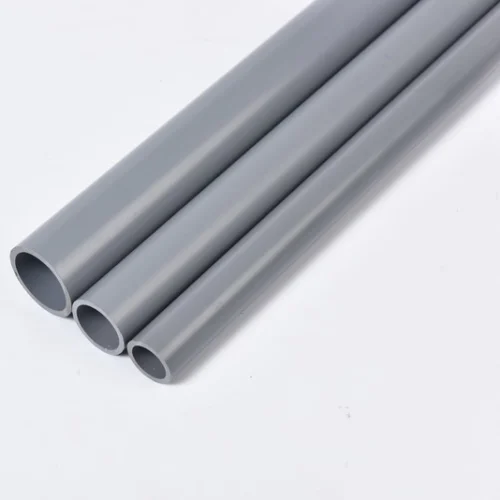
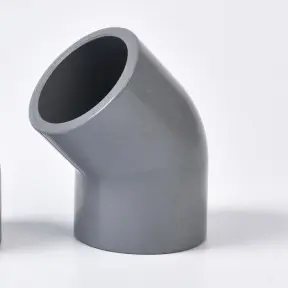
45° Elbow

Send Inquiry

Overview of 45° Elbow

Sikerui 45° Elbow​ is a precision-engineered pipe fitting designed to change the direction of flow in piping systems by 45 degrees, providing a balanced solution for directional changes with minimal pressure drop and optimal flow characteristics . This essential component is manufactured in various materials including carbon steel, stainless steel, alloy steel, brass, bronze, and specialized plastics to meet diverse application requirements from residential plumbing to industrial processing systems . Available in size ranges from 1/8 inch to 48 inches (DN15 to DN1200) and manufactured according to international standards such as ASME B16.9, ASME B16.11, and DIN 2609-1, the 45° elbow offers reliable performance under temperature extremes from -60°F to 300°F and pressure ratings up to 3000 class depending on material specification . The compact design and smooth inner surface reduce turbulence and friction loss, making it more efficient than 90° elbows for applications requiring gradual directional changes while maintaining system pressure and flow efficiency .
With configurations including long radius (LR) and short radius (SR) designs, threaded, socket weld, and butt weld connections, 45° elbows provide installation flexibility for various system requirements . Their robust construction ensures a service life matching the pipeline system, with corrosion-resistant materials maintaining performance in demanding environments including chemical processing, water supply facilities, HVAC systems, and industrial applications . The versatility and efficiency of 45° elbows make them indispensable components in modern piping systems where directional changes are required without significant pressure loss .

Key Features of 45° Elbow

Optimized Flow Efficiency

The 45° elbow design features a smooth inner surface​ that minimizes turbulence and friction loss, maintaining optimal fluid velocity and reducing pressure drop compared to sharper alternatives . The gradual 45-degree angle change ensures streamlined flow transition, which is particularly beneficial in pumping systems and applications where energy conservation is prioritized. This hydraulic efficiency contributes to lower operating costs and improved system performance over the long term .

Material Versatility and Compatibility

Available in a comprehensive range of materials including carbon steel, stainless steel (304/316), alloy steel, brass, bronze, PVC, and specialized alloys, 45° elbows can be selected to match specific application requirements regarding strength, corrosion resistance, and temperature tolerance . This material adaptability ensures compatibility with diverse media including water, chemicals, hydrocarbons, and abrasive slurries, making 45° elbows suitable for virtually any industrial or commercial application from food processing to chemical transport .

Space-Saving Design Configuration

The compact form factor of 45° elbows provides an optimal solution for limited space applications​ where a 90° elbow would be impractical . Available in both long radius (1.5D) and short radius (1.0D) configurations, these elbows offer design flexibility for different layout constraints while maintaining efficient flow characteristics. This space-efficient design is particularly valuable in retrofitting projects and equipment with spatial limitations .

Robust Construction and Durability

Manufactured to international standards including ASME B16.9, ASME B16.11, and DIN standards, 45° elbows deliver reliable performance​ under pressure fluctuations, temperature variations, and mechanical stress . The consistent wall thickness and precision manufacturing ensure structural integrity, while corrosion-resistant materials provide long service life even in aggressive environments. Pressure ratings typically range from 150 to 3000 class, depending on material and size specifications .

Installation Flexibility and Compatibility

With various end connections including threaded, socket weld, butt weld, and sometimes grooved or flanged options, 45° elbows accommodate different installation requirements and system designs . This compatibility with multiple joining methods simplifies system design, installation, and maintenance while ensuring secure, leak-proof connections. Standardized dimensions according to ASME, DIN, and JIS specifications ensure interoperability with existing piping components .

Typical Applications of 45° Elbow

Industrial Process Piping

In chemical plants, refineries, and manufacturing facilities, 45° elbows provide essential directional changes​ in process piping systems handling everything from water to aggressive chemicals . Stainless steel and alloy variants offer corrosion resistance for chemical processing, while carbon steel options provide cost-effective solutions for less demanding services. The 45-degree angle is particularly valuable for gradual turns that minimize pressure drop in pumping systems and energy transmission lines .

HVAC and Mechanical Systems

Heating, ventilation, and air conditioning systems utilize 45° elbows for efficient airflow direction​ in ductwork and piping . The balanced angle reduces turbulence and noise compared to sharper turns, contributing to system efficiency and occupant comfort. In hydronic systems, 45° elbows facilitate smooth directional changes that minimize pump energy requirements while maintaining compact system layouts .

Water Supply and Distribution Networks

Municipal water systems employ 45° elbows for gradual direction changes​ in distribution networks, treatment plants, and building services . The hydraulic efficiency of the 45-degree angle helps maintain pressure in transmission mains while accommodating terrain variations and infrastructure layouts. Material selections include corrosion-resistant options for potable water applications compliant with relevant health standards .

Oil and Gas Pipelines

In upstream, midstream, and downstream operations, 45° elbows provide reliable directional changes​ for hydrocarbon transport . Specialized materials including high-yield strength carbon steel and corrosion-resistant alloys ensure integrity under demanding pressure and temperature conditions. The gradual bend radius helps minimize erosion in high-velocity applications while accommodating pipeline route changes .

Power Generation Facilities

Power plants utilize 45° elbows in various systems including cooling water circuits, fuel supply lines, and steam piping​ . The precise angle change facilitates compact plant layouts while maintaining flow efficiency critical to generation efficiency. Material selection ranges from standard carbon steel for water services to high-temperature alloys for steam applications .

Technical Specifications

Table: Standard 45° Elbow Specifications
Parameter
Specification Range
Standards
Size Range
1/8″ to 48″ (DN6 to DN1200)
ASME B16.9, ASME B16.11
Pressure Rating
150 to 3000 class (material dependent)
ASME pressure classes
Temperature Range
-60°F to 300°F (standard); higher for specialty alloys
Material-dependent
Material Options
Carbon Steel, Stainless Steel, Alloy Steel, Brass, Bronze, PVC
Various ASTM standards
Connection Types
Threaded, Socket Weld, Butt Weld
ASME B16.11, ASME B16.9
Standards Compliance
ASME, ANSI, DIN, JIS, ISO, MSS
International standards

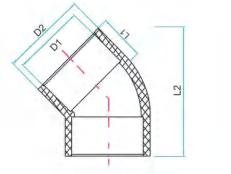
SIZE NO. D1 D2 L1 L2
DN15 XW15 20.3 26.3 16.5 47.36
DN20 XW20 25.3 31.9 19 55.18
DN25 XW25 32.35 39.95 22.5 66.79
DN32 XW32 40.4 49.8 26.5 79.65
DN40 XW40 50.45 60.25 31.5 95.83
DN50 XW50 63.5 75.9 38 116.16
DN65 XW65 75.5 88.91 44 141.61
DN80 XW80 90.55 105.15 51.5 166.39
DN100 XW100 110.6 127.39 61.5 197.19
DN125 XW125 140.6 161.4 76 248.87
DN150 XW150 160.7 184.5 86.5 280.95
dn200 XW200 200 228.1 106.2 344.5
DN200 XW200 226.2 253.8 118.5 389.7
dn250 XW250 250 283.4 131.5 424
DN250 XW250 281.5 315.5 147 465
DN300 XW300 316.7 355 165 538
DN350 XW350 356.8 395 185 600
DN400 XW400 402 442 208 660
DN250 (PN10) XW250 280.6 306 147 440
DN300 (PN10) XW300 315.7 344 165 495
DN350 (PN10) XW350 355.8 385 183.5 558
DN400 (PN10) XW400 401 432 208 620

Frequently Asked Questions (FAQs)

Q1: What is the difference between a 45° elbow and a 90° elbow in terms of application?
The primary difference lies in the degree of direction change​ and resulting flow characteristics. A 45° elbow creates a more gradual direction change with lower pressure drop and reduced turbulence compared to a 90° elbow . This makes 45° elbows preferable for applications where flow efficiency is prioritized, while 90° elbows are used where space constraints necessitate sharper turns. The 45° version also generates less stress on the piping system due to its more gradual bend .
Q2: How do I select the appropriate material for a 45° elbow?
Material selection depends on service conditions​ including fluid compatibility, temperature, pressure, and corrosion requirements . Carbon steel offers cost-effectiveness for general services, stainless steel provides corrosion resistance for chemical applications, and alloy steels accommodate high-temperature services. Consider compatibility with the connected piping and consult material specifications such as ASTM standards for guidance .
Q3: What are the advantages of long radius (LR) versus short radius (SR) 45° elbows?
Long radius elbows (1.5D bend radius) offer superior flow characteristics​ with lower pressure drop, making them ideal for high-efficiency applications . Short radius elbows (1.0D bend radius) provide a more compact solution for space-constrained installations but with slightly higher pressure drop. The selection depends on available space and hydraulic requirements of the specific application .
Q4: Can 45° elbows be used in high-pressure and high-temperature applications?
Yes, specifically designed 45° elbows can handle elevated pressures and temperatures​ based on their material specification and design standard . Butt weld fittings typically offer higher pressure ratings than threaded versions, and materials like alloy steels accommodate temperatures exceeding 1000°F in certain applications. Always consult pressure-temperature ratings for the specific material and standard .
Q5: What installation considerations are important for 45° elbows?
Proper installation requires attention to orientation, alignment, and welding procedures​ . For welded connections, ensure proper weld preparation and procedures compatible with the base materials. For threaded connections, use appropriate sealants and avoid over-tightening. Proper support placement is essential to prevent stress concentration at the connection points .
daiwang@skrpipe.com
+86 153-703-27218
Whatsapp